Skip to Main Content

Our Carmel location has moved! Visit us at 3404 E 146th St.

3404 E 146th St, Carmel, IN 46033
Mon 9:00AM - 6:00PM
Tue 9:00AM - 6:00PM
Wed 9:00AM - 6:00PM
Thu 9:00AM - 6:00PM
Fri 9:00AM - 6:00PM
Sat 10:00AM - 5:00PM
Sun Closed
333 S. 00 E.W., Kokomo, IN 46902
Mon 9:00AM - 6:00PM
Tue 9:00AM - 6:00PM
Wed 9:00AM - 6:00PM
Thu 9:00AM - 6:00PM
Fri 9:00AM - 6:00PM
Sat 10:00AM - 5:00PM
Sun Closed
8105 Kingston Street, Avon, IN 46123
Mon 9:00AM - 6:00PM
Tue 9:00AM - 6:00PM
Wed 9:00AM - 6:00PM
Thu 9:00AM - 6:00PM
Fri 9:00AM - 6:00PM
Sat 10:00AM - 5:00PM
Sun Closed

Our Carmel location has moved! Visit us at 3404 E 146th St.

How to Repair Water Damaged Laminate Flooring in Central Indiana

  • Updated on: August 7, 2026
  • Author: McCool's Flooring Team

How to Repair Water Damaged Laminate Flooring in Central Indiana

Not every laminate flooring damaged area needs to be replaced. The right fix depends on how much water got underneath the flooring and how long it stayed there.

In this guide, our team at McCool's Flooring explains how to assess the damage, go over two ways to repair water-damaged laminate, and help you figure out when it's time to call a flooring professional.

If you're unsure what to do with your flooring, our team is happy to take a look and help you choose the best next step.

Why Laminate and Water Don't Mix

Laminate flooring is built from layers of compressed fiberboard topped with a printed design layer and a wear layer. That fiberboard core is the problem. It's essentially dense wood pulp, and wood pulp absorbs water. Once it does, the planks swell, the edges lift, and the tongue-and-groove joints that hold everything together stop fitting the way they should.

This is exactly why water damaged laminate flooring shows up so often on our service calls.

Central Indiana homes deal with a real mix of moisture challenges throughout the year. Spring brings heavy rain and snowmelt that can push groundwater up against foundations in Hamilton, Hendricks, and Howard counties.

Summers get humid enough that basements without a dehumidifier stay damp for weeks at a stretch. And older homes throughout the Indianapolis metro, especially ones built before modern vapor barriers were standard, are more prone to slow moisture creep through the subfloor.

Add in the everyday culprits, a dishwasher supply line, a washing machine hose, a water heater that's starting to fail, and it's easy to see why this comes up so often.

According to the EPA's guide on mold and moisture, wet materials need to dry out within 24 to 48 hours to avoid mold growth, which is one more reason to act quickly once you spot swelling or warping in your laminate flooring.

Assess the Damage Before You Start

If the flooring sat underwater or stayed wet for an extended stretch, say after a burst pipe, a sump pump failure, or a slow leak that went unnoticed for weeks, the core of those boards has likely absorbed more moisture than it can recover from. At that point, full replacement is usually the right call. It's also worth having someone check the subfloor underneath for mold or soft spots before new flooring goes down.

If only a handful of planks near the source of the leak have swelled or separated, you're in much better shape. That's a project you can knock out over a weekend, as long as you can get your hands on matching flooring.

If you have no leftover boxes in the garage, you can bring a sample piece into one of our showrooms and we'll help you track down a match, or a comparable alternative if the original run has been discontinued.

Here's a tip from our team: check the planks a few feet beyond the visibly damaged area too. Damaged laminate flooring often looks fine on the surface while the tongue-and-groove edges have already started separating underneath. Press down gently along the seams. If you feel movement or hear a hollow click, that board needs to come out as well, even if it doesn't look swollen yet.

Quick Signs You're Looking at Repair, Not Replacement

  • Swelling or warping is limited to a small, defined area
  • No lingering musty smell in the room
  • The subfloor underneath feels dry and firm when you check it
  • Matching or close-enough replacement planks are available

Repairing a Few Damaged Planks (Perimeter Method)

This is the go-to method when damage is limited to a section near a wall or a corner, since laminate "floats" over the subfloor rather than being glued or nailed down.

  1. Remove the base molding along the affected wall to give yourself room to work.
  2. Laminate installs left to right with tongue-and-groove joints, so you'll work backward, lifting planks from right to left with a pry bar. Go slowly and protect your eyes.
  3. Label each plank with painter's tape as you remove it. This matters most when custom cuts are involved, since you can use the old piece as a template instead of measuring everything again.
  4. Swap in new planks where needed, making cuts to match as you go.
  5. Reinstall the undamaged, labeled planks in their original spots, then reattach the base molding.

This method works well because it doesn't disturb any flooring beyond what's actually damaged. You're essentially disassembling and reassembling the floor from the wall inward until you reach the bad boards.

Cutting Out Damage in the Middle of a Room

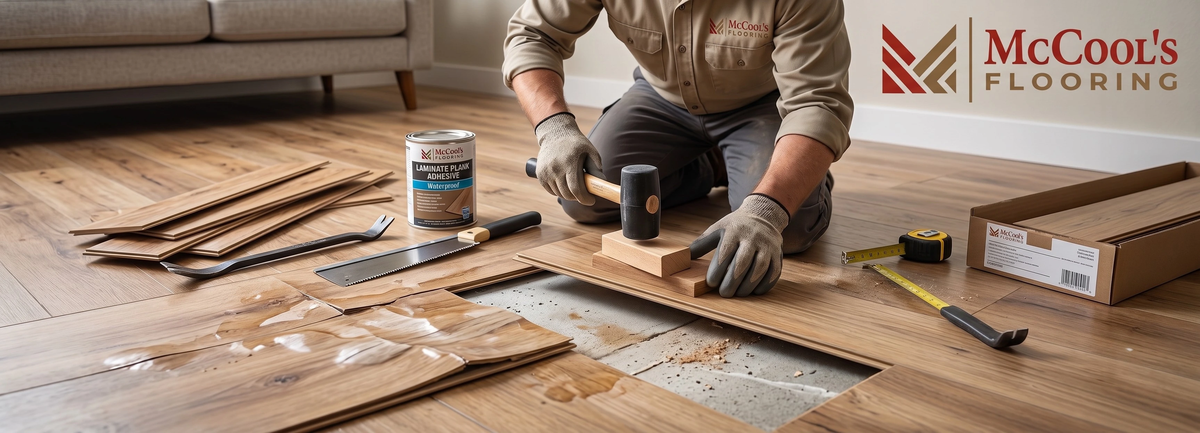
Damage in the center of a large room is trickier, since pulling up an entire section just to reach one bad plank isn't practical. A circular saw solves that problem, though this method takes a steadier hand than the perimeter approach.

Set your blade depth to match the thickness of the flooring, then measure the damaged board and mark a line one inch in from each end. That inch of clearance keeps you from nicking the neighboring planks.

Make a plunge cut, straight down through the surface, at each end mark, then connect them with a cut down the center of the damaged board. This lets you loosen and lift the piece out by releasing the tongue-and-groove edge. If it won't budge, a utility knife will finish the job.

Cut the replacement piece to length, then trim away its tongue-and-groove edge with a utility knife so it sits flush in the gap. This piece won't snap into place like the original did. Instead, run wood glue along the edges, set it in position, and wipe away any excess.

A rubber mallet and a scrap block will help seat it without marring the surface. Weigh the area down with a board and something heavy while the glue cures fully before anyone walks on it.

If you're not comfortable running a circular saw indoors or you're unsure about cutting close to good flooring, this is a reasonable point to call in a professional rather than risk a redo. Our full flooring installation team handles repairs like this every week.

What This Kind of Flooring Repair Typically Costs

For a straightforward repair involving a handful of planks near a wall or door, most homeowners in the Central Indiana area can expect to pay somewhere between $150 and $600, depending on how many planks need replacing and whether matching flooring is readily available.

A saw-cut repair in the middle of a room, which takes more labor and precision, typically runs $300 to $900. Full room replacement is a different conversation entirely and depends heavily on square footage and the laminate you choose, so it's worth getting a specific quote rather than relying on a general estimate.

If a full replacement is in the cards, it's worth asking our team about financing options to help spread out the cost.

These figures are general guidance only. For an accurate number based on your specific situation, contact us for a free estimate.

Preventing the Next Water Problem

Once the repair is done, it's worth thinking about why the damage happened in the first place. Slow leaks around dishwashers, refrigerator water lines, and washing machine hookups are the most common culprits we see, and they're easy to catch early with a quick check every few months.

Routine floor care also helps, since it gets you looking closely at your floors on a regular basis instead of only when something looks off.

If water damage keeps showing up in the same spot, that's usually a sign the room itself is a poor fit for laminate flooring. Kitchens, laundry rooms, and finished basements are exactly where waterproof flooring options like luxury vinyl plank tend to make more sense long term. It looks and feels similar to laminate flooring but won't swell or delaminate if it gets wet, which makes it a smart upgrade for moisture-prone rooms.

According to the North American Laminate Flooring Association, the industry group that sets performance and certification standards for laminate products, even water-resistant laminate lines aren't built to withstand standing water the way waterproof flooring is.

Frequently Asked Questions

It depends on how much water exposure occurred. A few swollen planks near a leak source can usually be repaired individually, and we cover both repair methods in this guide to water damage and flooring.

Flooring that was submerged or stayed wet for days typically needs full replacement, along with a subfloor check for hidden moisture or mold.

Yes. Waterproof flooring, particularly luxury vinyl plank, holds up to standing water and humidity far better than laminate flooring does. If a room keeps having water issues, or if you're finishing a basement, it's worth exploring during your next flooring installation.

Our basement flooring options guide covers this in more detail.

We carry a wide range of trusted brands, including Aladdin Commercial, Shaw Floors, Anderson Tuftex, Godfrey Hirst, Karastan, Mohawk, and more.

Since we only install what we sell, our team knows these products inside and out, from how they handle moisture to how they perform over years of everyday life.

Not Sure Which Way to Go? Let's Take a Look

Every water damage situation is a little different, and it's hard to know from a few photos whether you're looking at a weekend fix or something bigger.

While you're rethinking a moisture-prone room, it's worth browsing our full lineup of flooring products, too.

Some homeowners land on carpet for bedrooms once the laminate comes out, others go with engineered hardwood in drier living spaces, and a lot of people finish the look with an area rug over the new floor once installation wraps up.

Stop by our showroom in Carmel, Avon, or Kokomo, or contact us to talk through what you're seeing.

We'll help you figure out the right fix, whether that's a quick repair or a conversation about flooring installation that can better handle moisture going forward.

Contact us to get started!

No obligations — let’s discuss your project and see how we can help!

Carmel Showroom

Mon 9:00AM - 6:00PM
Tue 9:00AM - 6:00PM
Wed 9:00AM - 6:00PM
Thu 9:00AM - 6:00PM
Fri 9:00AM - 6:00PM
Sat 10:00AM - 5:00PM
Sun Closed

Start Your Project

Let one of our experts help you find the perfect floor!

Your Info

Success!

Thank you! We'll be in touch shortly.